Top quality meets a low carbon footprint: the new RAL Climate Premium Pellets Quality Mark
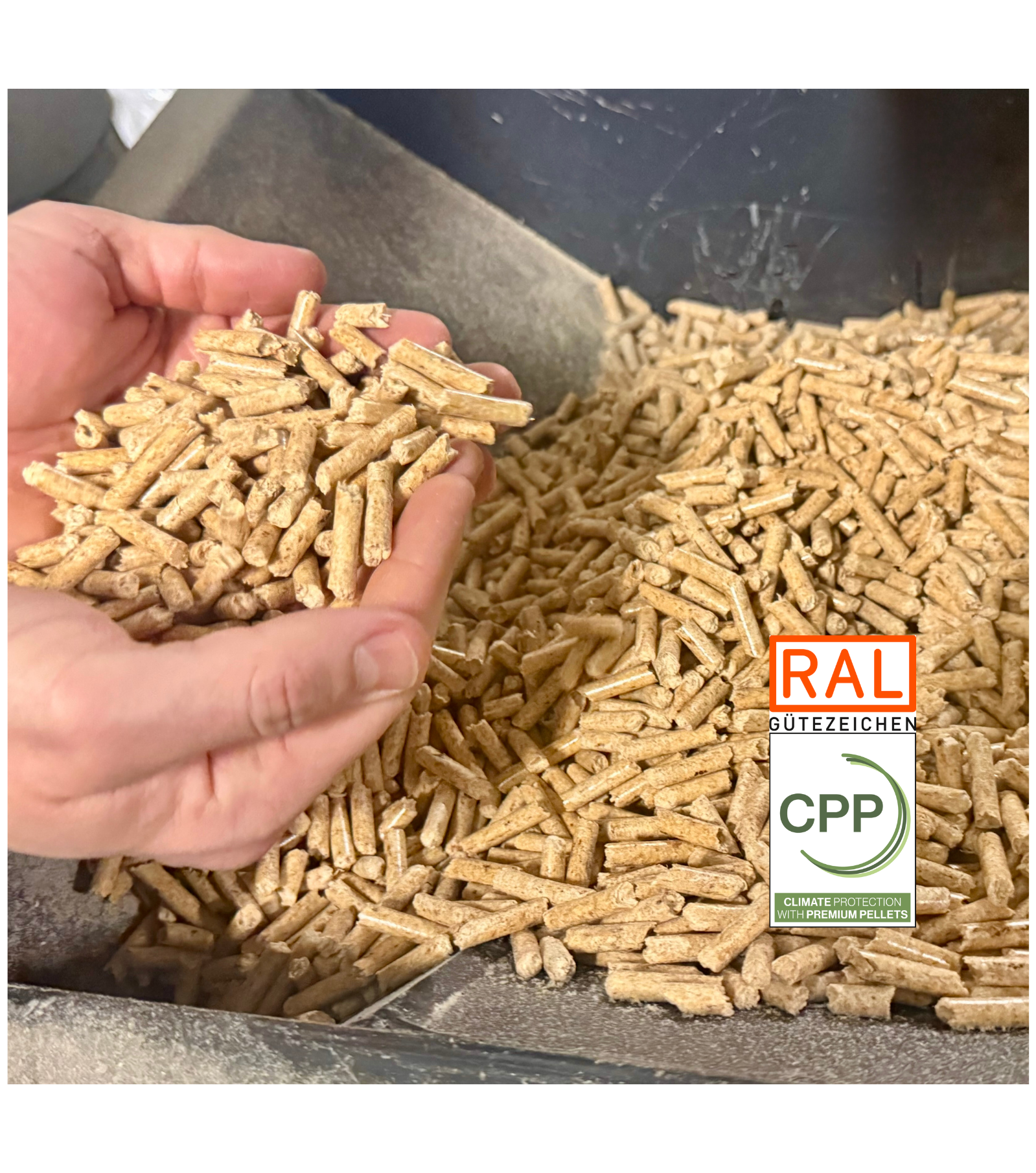
The RAL Quality Mark Climate Premium Pellets (CPP) guarantees particularly high product quality as well as resource-efficient and regionally sourced production of the pellets. In many respects, the requirements exceed the standards of property class A1 set out in the internationally recognised DIN EN ISO 17225-2 standard for wood pellets, ensuring reliable, low-emission combustion. The use of high-quality, quality-assured pellets enables efficient and trouble-free heating system. The pellets burn cleanly and, thanks to their low ash and dust content, the equipment is protected and maintenance requirements are reduced. The high product quality is ensured through ongoing internal checks, external laboratory analyses and regular independent audits.
In addition to their high product quality, Climate Premium Pellets are characterised in particular by their environmentally and climate-friendly production. They are generally produced from chemically untreated residues from the sawmill and timber industry or other wood-processing businesses. In individual cases, small quantities of forestry residues that are unsuitable for higher-quality timber products are also used. Sawdust and wood shavings are produced in large quantities in sawmills as well as in cross-laminated timber, glued laminated timber or planing mills, and are usually compressed into pellets directly on site or in the immediate vicinity. This avoids additional transport distances and the associated emissions.
The material must also comply with the principles of the SURE scheme (Sustainable Resources Verification Scheme) for biomass, which defines sustainability criteria throughout the entire value chain. In addition to product and raw material quality, criteria relating to regionality, the efficient use of resources and the improvement of the greenhouse gas balance must also be met. These are verified against additional requirements under the SURE-EU system and serve to ensure short transport routes, production that is as climate-friendly as possible, and an overall very low carbon footprint.
Pellet production is also designed with climate protection in mind: for instance, the process heat required for drying the raw material is predominantly generated in the company’s own biomass combined heat and power plants directly on site. Renewable electricity and heat are produced from residues such as forest residues, bark, landscape management material or prunings in a highly efficient combined heat and power process.
“Climate Premium Pellets meet stricter quality, raw material and sustainability requirements than usual standards,” explains Julia Möbus, Managing Director of the new RAL Quality Assurance Association. “The RAL Quality Mark thus stands for regionally produced pellets made from untreated waste materials with a proven good carbon footprint.”
Futher information:
Gütegemeinschaft
Climate Premium Pellets e. V.
Chausseestraße 99
10115 Berlin
E-Mail: info@climatepremiumpellets.de