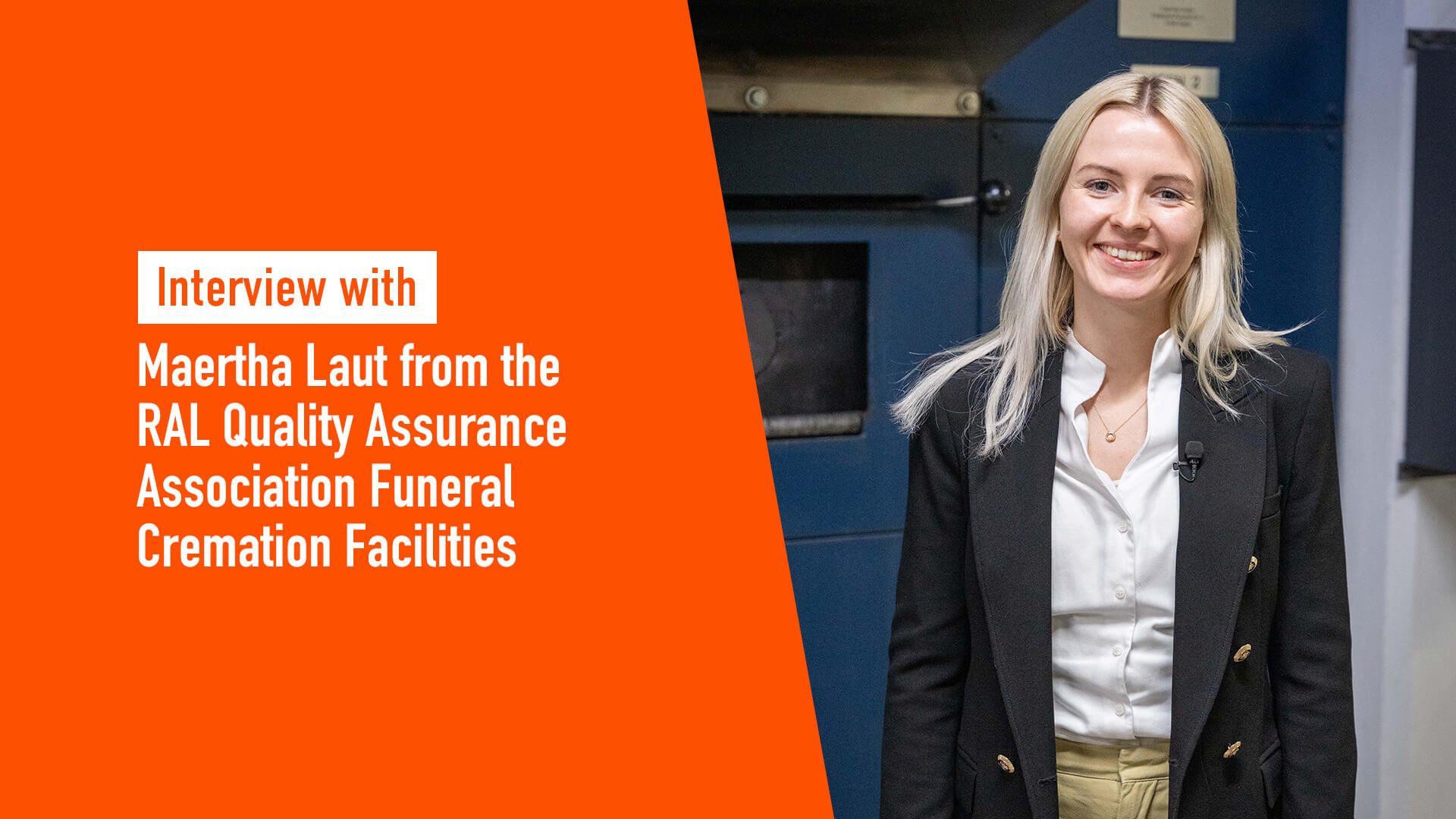
Five questions for Maertha Laut from the RAL Quality Assurance Association for Cremation Facilities
- Cremations are becoming increasingly common. Why do you think that is?
The way Germans say goodbye to their deceased loved ones has fundamentally changed in recent years. While traditional burial in a coffin used to be the norm, it has now become the exception. Cremation followed by burial of the ashes in an urn now dominates the German funeral landscape. In 2024, 81% of funerals nationwide were cremations.
There are many reasons for this: urn graves require less space, resting periods are shorter and maintenance and gravestone costs are lower. The lack of space in cities is an important factor – many municipalities are responding by offering urn graves, columbaria or forest burials. Added to this is social change: ties to the church are becoming less important, and urbanisation and rising costs mean that cremation is increasingly being accepted as a practical alternative. Another advantage is that urns allow for more burial options, such as earth urn graves, columbariums and natural burials. This enables relatives to select a resting place that truly reflects the wishes of the deceased.
In short, cremation represents a modern, personalised approach to remembrance. Where new forms, such as forest burials or scattering ashes, are permitted, cremation becomes more appealing. The relaxation of burial periods and the acceptance of natural forms of burial are promoting this development. - The new federal states have a particularly high percentage of cremations. Why is that?
Cremation has long been the norm in these states and was promoted by the state in the former German Democratic Republic (GDR). Religious ties also play a smaller role there than in other parts of Germany. The proportion of cremations in almost all of the new federal states is between 90 and 96 per cent. (The only exception is Berlin.) In 2024, Saxony-Anhalt led the way with 96 per cent of cremations. In September 2025, the state passed a new funeral law allowing burials without coffins and extending the period for urn burials to six months. This is the state’s response to changing wishes and cultural diversity. - But who actually owns the mortal remains?
In principle, the remains, like the corpse, belong to no one. The person responsible for the deceased has the right to claim the metals released after cremation, such as dental gold or titanium implants. In practice, they usually transfer this right to the crematorium by signing a cremation order. Some crematoria donate the proceeds from selling these metals to charitable causes. - What makes the RAL Quality Mark for Cremation Facilities (RAL Gütezeichen Feuerbestattungsanlagen) special?
The RAL Quality Assurance Association for Cremation Facilities awards crematoria in which dignity and quality are paramount. This was necessary because, until recently, crematoria were purely functional buildings. Sensitive treatment of the bereaved and the deceased, and a solemn setting for the highly emotional process of cremation, were not guaranteed. Crematoria that have joined together under the RAL Quality Mark therefore voluntarily exceed legal requirements.
Modern crematoria now see themselves as service providers for the deceased and their relatives. Our aim is to provide the bereaved with a sense of security and compassion. They should feel that the person they are mourning is in good hands with us.
As a Quality Assurance Association, we are also dedicated to improving the cremation process itself. Until 2012, there were no reliable figures on the ratio of coffin to urn burials in Germany. Since then, we have conducted an annual survey (in German) on this topic. - ‘Alive in the coffin’ is a primal fear of humanity, and the issue was recently in the news again following an incident in Thailand. Hand on heart: how real is this danger?
We can refute this primal fear outright. It is practically impossible for someone to be alive in a coffin during cremation. Before cremation, a second post-mortem examination by a public health officer is required by law. This is usually carried out by a forensic pathologist or public health officer. This second check (the four-eyes principle) ensures that death has definitely occurred and that an unnatural cause of death has been ruled out. Otherwise, cremation may not take place.
In addition, almost all German federal states stipulate a minimum waiting period between death and cremation. This is usually 48 hours. This ensures that any signs of life can be checked, identity can be verified, and that no living person is cremated by mistake.