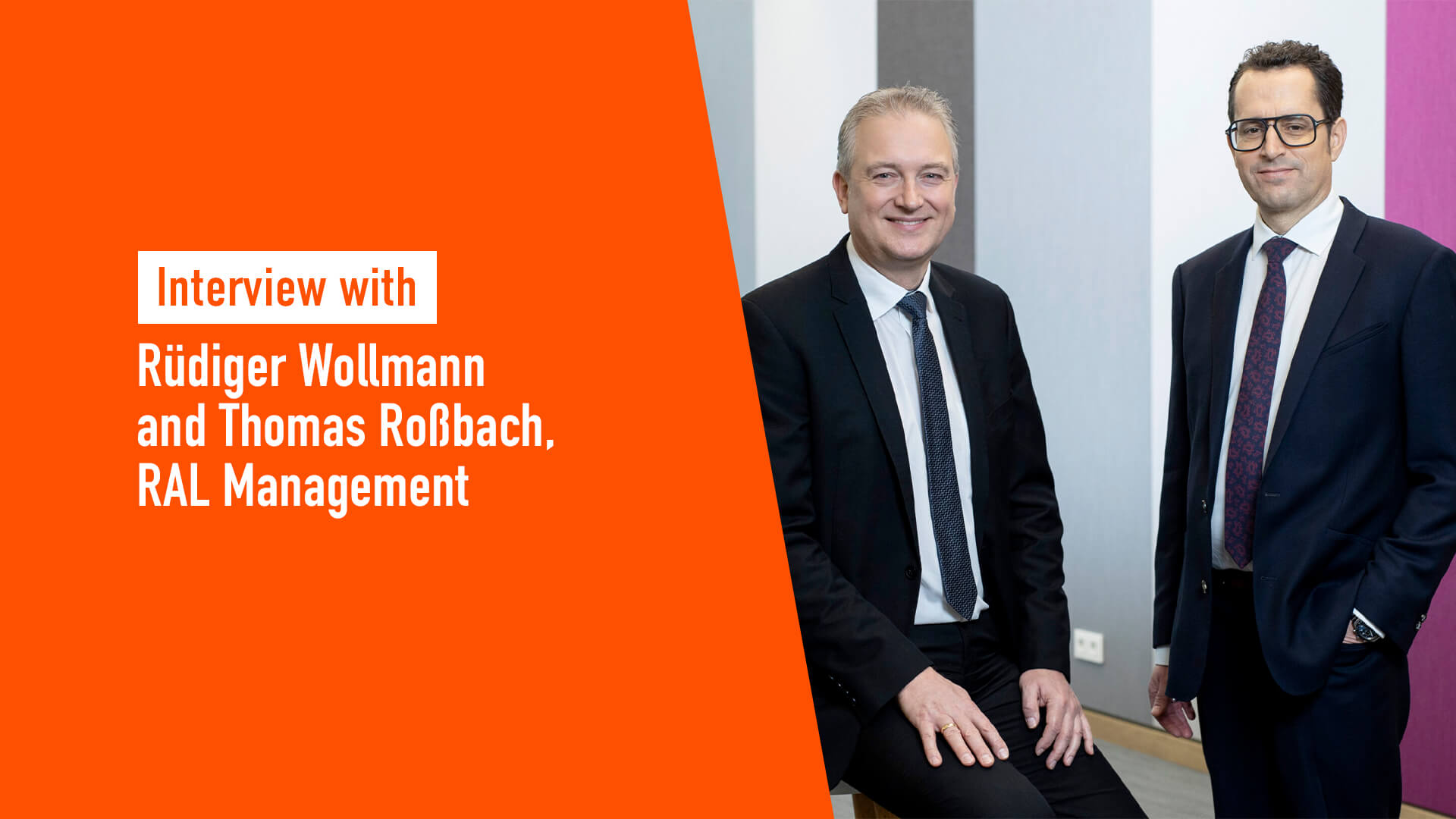
New Year, new challenges: An interview with Rüdiger Wollmann and Thomas Roßbach, RAL Managment
Which topics will be important for RAL Quality Marks in 2026?
Rüdiger Wollmann: The EmpCo Directive is currently a major topic for us. Through this directive, the EU is tightening the rules for environmental claims and taking action against greenwashing. In future, claims such as ‘recycled’ or ‘sustainable’ will need to be supported by concrete figures and examples. In addition, only sustainability labels that are government seals or based on a recognised certification system may be used for communication purposes. In Germany, the requirements of the EmpCo Directive are implemented in the Gesetz gegen den unlauteren Wettbewerb ( Unfair Competition Act), which will come into force on 27 September 2026 without any transition period. Consequently, we are currently receiving a large number of enquiries from companies whose own environmental labels will lack a legal basis in future. The RAL Quality Mark system is EmpCo-compliant and can be used for reliable sustainability communication. This is an important issue for us!
Thomas Roßbach: In addition, two major topics have been on our minds for some time: Firstly, the transformation of the economy into a true circular economy. In many areas, there is still a lack of legal requirements or standards. RAL Quality Marks offer the opportunity to close this gap and set new private law standards in order to use resources more efficiently and reduce waste. Secondly, the digital product passport. This will initially be introduced for batteries in 2027, with other product groups to follow. In future, it will make the origin of raw materials, reparability, recyclability and even the high quality of a product more transparent and accessible to everyone.
The circular economy is a good keyword and an important topic of our time – but is it more than just a buzzword at RAL?
Rüdiger Wollmann: Definitely, and on many levels! On the one hand, there are RAL Quality Marks that are directly active in this area. I am thinking, for example, of the % Recycled Plastic Quality Mark, which members can use to indicate the exact percentage of recycled materials from the ‘yellow bag’ in their products or packaging. The RAL Quality Mark for Furniture Circular Sustainable sets strict requirements for resource efficiency, ease of repair, recycling content, durability and more. The RAL Quality Mark for Resource Management identifies services dedicated to the return, reuse and recycling of valuable materials in the material cycle. These are just three examples. Many other quality associations have expanded their quality and testing regulations to include circular economy requirements in recent years. And then there is the RAL Forum, our annual event featuring numerous presentations and discussions, which has focused on circular economy topics for the past three years. We want to play an active role in transforming the economy into a circular economy.
Can you give us a glimpse behind the scenes – which RAL Quality Marks will be added soon?
Thomas Roßbach: I can reveal that two new RAL Quality Marks are currently being approved: the RAL Climate Premium Pellets Quality Mark and the RAL Sustainable Gastronomy Quality Mark (working title).
In your opinion, which RAL Quality Marks are still missing?
Thomas Roßbach: A few years ago, we discussed sponge cities at a RAL Forum. I learned that not all building materials are suitable for sponge cities as they can contaminate the collected water. Since then, I have liked the idea of a RAL Quality Mark for sponge city-suitable building materials, even though it has not progressed beyond the idea stage so far.
Rüdiger Wollmann: My example also comes from a RAL Forum – the RAL Forum on secondary raw materials, which we held last October. Lukas Hädicke from the ARDEX Group presented a product for laying tiles that can easily be removed, reused and recycled. It is such an innovative product for circular construction chemistry that there is currently no standard for it and it cannot be called ’tile adhesive’. I could well imagine that a RAL Quality Mark for circular construction chemistry could ensure high quality and set new standards in this area.